

Where to Install Aircon Units, Inside and Out
Deciding where to install aircon units affects how well the room cools, how much noise you hear and how easy future servicing will be. Here's how to get both positions right before anyone picks up a drill.
A good unit in a poor position never performs as it should. Put the indoor unit in the wrong corner and half the room stays warm. Squeeze the outdoor unit into a hot, airless gap and it works harder, costs more to run and wears out sooner.
Fortunately, deciding where to install aircon units is mostly a matter of knowing what the installer is weighing up. This guide focuses on a standard wall split, the setup most homes use, though the same principles apply to other systems.
Positioning the indoor unit
Let the air travel across the room
A wall split throws air forward and outward from its louvres. It works best mounted on a wall where that airflow can travel along the longest open stretch of the room, not straight into a bookshelf, a beam or a wall a metre away. In an L-shaped or open-plan space, aim it towards where people actually sit.
Don't aim it at the bed or the desk
Cold air blowing directly onto someone sleeping or working is uncomfortable and leads to people setting the temperature higher, then complaining it doesn't cool. In bedrooms, a wall beside or opposite the foot of the bed usually works better than directly above the headboard pointing down. The louvres help, but they can't fix a bad position.
Get the height right
Wall splits are mounted high because cool air sinks. Most draw air in through the top of the unit, so they also need a gap between the unit and the ceiling. The installation manual for each model gives the minimum clearances, and a good installer follows them rather than tucking the unit tight against a cornice.
Keep it away from heat sources
The indoor unit measures room temperature at its own air intake. If it sits above a stove, a heater, a TV or a sunny window, it reads a false temperature and the room ends up too cold or not cold enough. Avoid mounting it directly above electronics or furniture that can't get wet, in case a drain ever blocks.
Plan the drain and service access
Condensate water has to run downhill from the indoor unit to a sensible point outside. An external wall with a garden bed or drain point below is ideal. An internal wall may need a condensate pump. The technician will also need ladder access in front of the unit to clean filters and service it, so avoid spots blocked by built-in cupboards or a staircase.

Where to install aircon outdoor units
Shade without suffocation
The outdoor unit releases the heat removed from your home, and it does that more easily when the air around it is cooler. A spot out of the harsh afternoon sun helps, which is why a north or west wall in full sun is often a second choice. Shade must never come at the cost of airflow, though: an outdoor unit boxed into a narrow alcove ends up breathing its own hot exhaust.
Respect the clearances
Every outdoor unit needs open space behind, beside and in front of it, as set out in its installation manual. The front, where the fan blows out, needs the most room. Don't face the discharge into a wall close by, a neighbour's window or another outdoor unit.
Think about noise
Modern outdoor units are fairly quiet, but you'll still hear the fan and compressor at night in a quiet suburb. Keep the unit away from your own bedroom windows and, just as important, from your neighbour's. Brackets should use anti-vibration rubber mounts so the hum doesn't travel through the wall.
Bracket or ground?
A wall bracket keeps the unit out of the way of children, pets, garden equipment and pooling rainwater, and it needs a solid wall that can take the weight. A ground position is easier to service and suits single-storey homes with a side passage. Ground units should sit on a level concrete slab or plinth, raised clear of standing water. Remember that in heating mode the outdoor unit produces defrost water too, so the area around it should drain.
Security cages
Theft of outdoor units and their copper is a real concern in some areas, so many owners add a cage. Choose one with open mesh that doesn't restrict airflow, and make sure it can be unlocked or removed for servicing.
Linking the two: pipe length and route
The indoor and outdoor units are connected by refrigerant pipes, a cable and the drain line. Shorter, simpler runs are better for performance and cost less. Every model has a maximum pipe length and a maximum height difference between the two units, listed in its manual, and those limits are not negotiable. Runs longer than the factory-charged length also need extra refrigerant added.
Pipe routes should be neat, protected in trunking where exposed, and planned so the drain line falls continuously. Extra pipework is one of the main reasons quotes differ, as we explain in what affects installation cost.
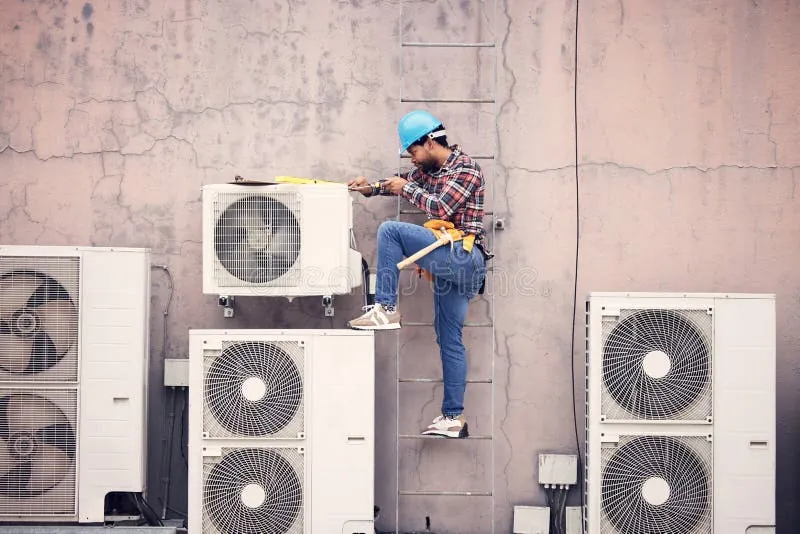
Placement checklist before installation day
Run through this list when deciding where to install aircon units, ideally with your installer on site.
- Indoor airflow. The unit can throw air along the room, not into an obstruction.
- Comfort. It won't blow directly onto a bed, couch or desk.
- Clearances. Ceiling gap above the indoor unit and open space around the outdoor unit, as per the manual.
- Heat sources. No stove, heater, TV or sunny window right beside the indoor unit.
- Drainage. A downhill route to a suitable outside point, or a pump planned in.
- Noise. Outdoor unit away from bedrooms, yours and the neighbours'.
- Mounting. A solid wall for a bracket, or a level, raised base on the ground.
- Pipe run. Within the model's length and height limits, as short as practical.
- Service access. Room for a ladder at the indoor unit and a technician at the outdoor unit.
- Approvals. Body corporate or HOA consent in hand, if you live in a complex or estate.
Unhappy with where your aircon is now?
Units installed in the wrong place can usually be moved. We do aircon relocation for split units, including safely disconnecting, refitting and recommissioning them. For new systems, our installation service starts with a site assessment so placement is decided before the job is priced. To have someone look at your home or office, request a free quote or call 0861 995 092. We cover residential and commercial properties across Gauteng.

Get the placement right first time
A site assessment settles where both units go before the drilling starts.