

Aircon Regassing in Gauteng
If your unit is low on refrigerant, it has a leak. ARS approaches aircon regassing the way it should be done: find the leak, repair it, prove the system holds pressure, then recharge with the correct refrigerant and the correct amount.
Refrigerant Doesn't Get Used Up
A common belief is that an air conditioner burns through its gas like a car burns petrol and needs a fill-up every year or two. It doesn't. Refrigerant circulates in a sealed loop, changing from liquid to vapour and back, carrying heat out of the room. In a sound system, the charge put in on installation day is the charge it should still have years later.
So when a unit is genuinely low, refrigerant has escaped somewhere. That changes the job. Adding gas without dealing with the leak means paying to release it into the atmosphere again over the following weeks or months.
Signs Your Unit May Be Low on Refrigerant
- Cool but not cold. The air coming out is only slightly cooler than the room, and gets worse over time.
- Ice where it shouldn't be. Frost on the indoor coil or on the thinner copper pipe at the outdoor unit's service valves.
- Running without a break. The unit never reaches the set temperature, so it never rests.
- Oily marks at joints. Refrigerant carries compressor oil with it, so a leak often leaves a greasy, dust-caked patch at the leaking point.
- Hissing or bubbling. A faint sound near the pipes or the indoor unit can point to a larger leak.
- Protection error codes. Many units shut down and flash a code when pressures or temperatures fall outside normal limits.
Several of these overlap with plain dirty filters or a blocked outdoor coil, which are far cheaper to fix. Our article on the signs your aircon needs regassing helps you tell the difference before you call.
How Aircon Regassing Should Be Done
Confirm it's really the gas
Temperatures and pressures are measured and compared with what the unit should be doing. Airflow and electrical faults are ruled out, so nobody regasses a unit that only needed a clean.
Find the leak
Flare nuts, service valves, valve cores, coils and any spot where a pipe rubs against a bracket or wall are checked with an electronic leak detector and bubble solution.
Repair it
Flares are remade, joints brazed, valve cores replaced or damaged pipe sections renewed. A leaking coil may need replacing, and that's when the repair-or-replace question comes up.
Pressure test and vacuum
The circuit is pressurised with dry nitrogen and watched to confirm it holds. Then it's evacuated with a vacuum pump to remove air and moisture before any refrigerant goes back in.
Charge by weight and verify
Only the correct refrigerant goes in, weighed against the charge on the unit's rating plate. The system is then run and its pressures and air temperatures checked.
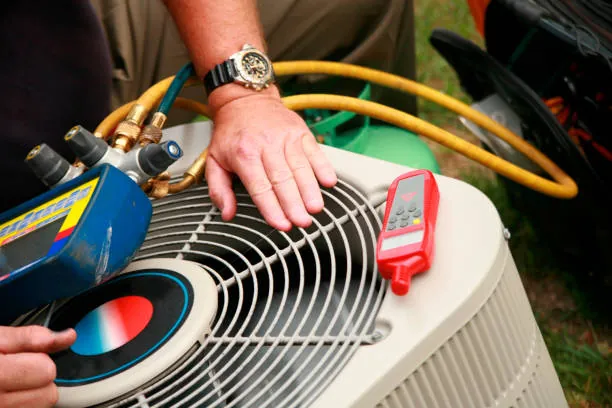
R22, R410A and R32: Three Refrigerants That Don't Mix
Your unit's refrigerant is printed on the rating plate, usually on the side of the outdoor unit. It isn't interchangeable.
| Refrigerant | What it is | Where you'll find it | What to know |
|---|---|---|---|
| R22 | HCFC | Older units | Damages the ozone layer and is being phased out under the Montreal Protocol. Supply in South Africa is tightly restricted and shrinking. No new units are made for it. |
| R410A | HFC blend | Many units from the last couple of decades | Doesn't harm the ozone layer but has a high global warming potential. Runs at much higher pressures than R22. |
| R32 | HFC, single refrigerant | Most newer inverter splits | About a third of R410A's global warming potential. Classed as mildly flammable (A2L), so it needs the correct handling, tools and procedures. |
Why mixing them causes damage
Each refrigerant is matched to its own operating pressures and its own type of compressor oil. R22 systems typically use mineral oil, while R410A and R32 systems use synthetic oils. Mixing refrigerants, or charging the wrong one, gives unpredictable pressures, poor cooling and a real risk to the compressor. It also contaminates the refrigerant, so it can't simply be recovered and reused. R32 is not a retrofit for R410A units: a unit is designed for one refrigerant and should stay on it.
What the R22 phase-out means for you
South Africa has been cutting HCFC imports in steps for years, and the amount of R22 allowed into the country is now a small fraction of what it once was. Existing R22 units can still be repaired and recharged with what's available, but supply is limited. If an R22 unit has a significant leak or a tired compressor, it's usually worth comparing the repair with a new unit. The full background is in our guide to aircon refrigerants R22, R410A and R32.
Why Seasonal Top-Ups Waste Money
Some units get "a bit of gas" every spring for years. Each top-up costs a call-out and refrigerant, and in between, the system runs undercharged, which means weaker cooling, higher electricity use and extra strain on the compressor. Ice on an undercharged coil can also drip and cause water damage indoors.
Finding and fixing the leak usually costs more on the day than a top-up, but it's the last time you pay for that problem. If your unit has needed gas more than once, ask us to quote a leak repair and aircon regassing or call 0861 995 092. Where the leak is part of a bigger fault, it's handled under aircon repairs, and where the unit isn't worth saving, our installation service covers the replacement.
We regas units across Gauteng, including homes in Edenvale, Bedfordview and Krugersdorp.
Regassing Questions
In normal circumstances, never. The refrigerant circulates in a sealed system and is not consumed. If a unit needs gas, it has a leak, and the leak should be repaired before it is recharged.
A top-up on a leaking system only buys time, and the refrigerant escapes again. We will always explain where the leak is and what the repair involves so you can make an informed decision rather than paying for gas repeatedly.
Look for the rating plate on the outdoor unit. It lists the refrigerant type and the factory charge, usually in kilograms or grams. Mention it when you call, along with the brand and model.
Yes, but in limited and shrinking quantities, because South Africa is phasing out HCFC refrigerants under the Montreal Protocol. Older R22 units can still be repaired, but for a unit with a major fault, replacement is often the more sensible choice.
No. R32 runs at different pressures and needs components designed for it. Moving to R32 means installing a unit built for R32.
R32 is classed as mildly flammable, and units that use it are designed with that in mind. The risk is managed through correct installation, leak-tight pipework and proper handling during servicing, which is one more reason refrigerant work should only be done by someone registered to do it.
The recharge itself is not the long part. Finding the leak is. A leak at a flare joint can show up quickly, while a pinhole inside a coil takes longer to trace. If parts are needed for the repair, the recharge waits until the leak is fixed.

Fix the Leak Once, Not the Symptom Every Summer
Request a free quote for leak detection, repair and a correct recharge anywhere in Gauteng.