

Aircon Repairs in Gauteng
ARS does aircon repairs on site, at your home or business, on all makes and models. We find out why the unit has stopped doing its job, explain it in plain language and quote the fix before any work goes ahead.
An air conditioner that's blowing warm air, dripping on the carpet or tripping the DB board rarely has a mystery cause. It usually has one of a dozen familiar ones. The skill is in proving which one, rather than swapping parts until the symptom goes away.
That's why every visit starts with testing at the unit itself. Your aircon stays where it is, and we bring the gauges, meters and tools to it. Wall splits, cassettes, ducted units, floor-standing and under-ceiling units, inverter and non-inverter, old and new.
Common Faults Behind Most Aircon Repairs
- Not cooling, or cooling weakly. Blocked filters, a dirty outdoor coil, a failed fan, a refrigerant leak or a compressor that isn't starting. Our article on why an aircon is not cooling covers the checks you can do first.
- Not heating in winter. On a reverse-cycle unit this often points to the reversing valve, a sensor or the outdoor unit struggling through its defrost cycle on frosty Highveld mornings.
- Water leaking from the indoor unit. Almost always a blocked drain line, a cracked or dirty drain tray, or a unit that wasn't mounted level.
- Noisy operation. Rattles from loose panels or brackets, squeals from fan bearings, or a fan blade catching on ice or debris.
- Tripping the breaker. Anything from a shorted fan motor or a failing compressor to a loose termination or an undersized circuit.
- Error codes flashing. The code points to a system (a sensor, communication between units, high pressure) but the meaning differs by brand and model, so it narrows the search rather than ending it.
- Dead after a storm or load shedding. Power surges when the grid comes back, and lightning strikes nearby, can damage the control board (PCB) or the remote receiver.
- Fan motors and capacitors. A capacitor that has lost its strength is a common reason a fan or non-inverter compressor hums but won't start.
- Compressor problems. The expensive one. We test properly before condemning a compressor, because the cause is sometimes a cheaper electrical part.
- Gas leaks. A unit low on refrigerant has a leak. We find it, fix it and recharge through our aircon regassing service, rather than simply topping up.
How a Repair Visit Works
- You describe the symptoms. What it's doing, when it started, any error code on the display, and whether anything happened just before, such as a storm, a power cut or building work.
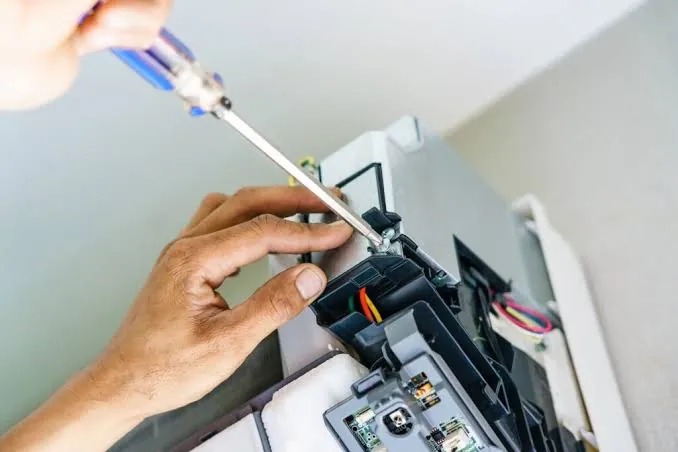
- We test at the unit. Electrical readings on the supply, fans and compressor, refrigerant pressures where relevant, sensor values and the drainage. Indoor and outdoor units both get looked at, because the symptom inside often starts outside.
- You get the cause and the options. We tell you what's failed, why, and what it takes to fix it. If there's a choice between repairing and replacing, we lay out both honestly.
- The repair, once you approve it. Simple items such as capacitors, sensors and drain fittings are generally quick to replace. Brand-specific boards, motors and compressors may need to be ordered first.
- Testing before we leave. The unit runs through a full cycle so you can see it working, not just hear that it should be.
Repair or Replace? An Honest Answer
Most aircon faults are worth repairing. A new capacitor, a cleared drain or a replaced sensor costs a fraction of a new unit. The sums change when a unit is older, runs on R22 refrigerant that is being phased out, and needs a compressor or a main board. At that point, putting serious money into it is a gamble.
We'll tell you when we think you've reached that point, and why. Our guide on whether to repair or replace an old aircon walks through the same reasoning, and if replacing makes more sense, we can size and fit the new unit through our aircon installation service.
What Affects What a Repair Costs
Every quote is specific to the fault, but these are the things that move it up or down:
- The part involved. A sensor or capacitor is a small item. A compressor, inverter board or fan motor for a specific model is not.
- Refrigerant work. Leak finding, brazing, pressure testing and recharging all take time and materials.
- Access. A ground-level condenser is quicker to work on than one on a third-floor bracket or a roof.
- Unit type and age. Ceiling cassettes and ducted units take longer to open up, and parts for older models can be harder to find.
We repair units across Gauteng, from homes in Alberton and Kempton Park to offices in Pretoria. Several areas have their own repair pages with local detail, including aircon repairs in Randburg, air conditioning repairs in Sandton, aircon repairs in Boksburg and aircon repairs in Krugersdorp.
If your unit is acting up, book a repair visit or call 0861 995 092 and describe what it's doing.
Aircon Repair Questions
Yes. We work on all makes and models of split, cassette, ducted, floor-standing and under-ceiling units. Some brand-specific parts may need to be ordered, which we will tell you upfront.
Switching it off at the isolator for a few minutes and back on can clear a glitch after a power cut. If the fault comes back, or the breaker trips again, leave it off. Repeatedly resetting a unit with a real fault can do further damage.
It tells the technician which part of the system the unit has flagged, such as a sensor, the outdoor unit or communication between the two. The same code can mean different things on different brands, so note it down along with the model number when you call.
Musty smells usually come from dust and moisture on the indoor coil, blower wheel or drain tray. A proper service normally sorts it. A burning or electrical smell is different: switch the unit off at the isolator and have it checked before using it again.
Not necessarily broken, but something is wrong. Ice forming on the indoor coil, a dirty outdoor coil causing high pressure, or a fan or sensor fault can all make a unit cool and then cut out. It needs testing to know which.
No. Emergency call-outs are available 24 hours a day, seven days a week, including weekends and public holidays, for situations that cannot wait for a normal booking.
Find Out What's Really Wrong With Your Aircon
Book an on-site repair visit anywhere in Gauteng and get the cause explained before you approve the fix.